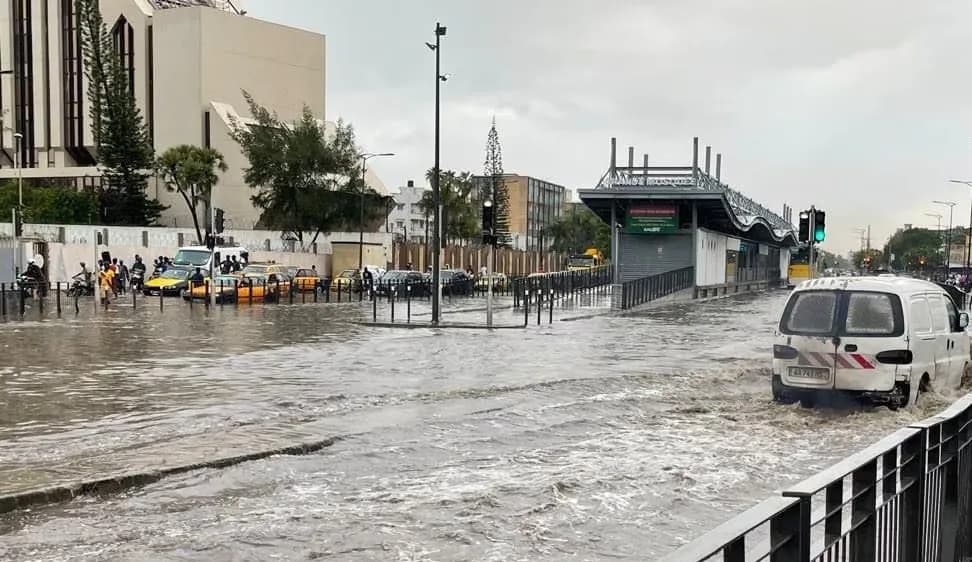
In Senegal, and particularly in Dakar, the rainy season remains a worrying period for the inhabitants of the capital due to a problem that has persisted for decades: flooding.
In Dakar, the lack or insufficiency of sanitation infrastructure is an aggravating factor, limiting the evacuation of rainwater and promoting its stagnation during heavy rainfall. This situation leads to health, economic, and urban consequences, including the degradation of roads and the risks associated with stagnant water. It thus reveals a double responsibility: institutional, through the planning, construction, and maintenance of infrastructure, and collective, through civic responsibility and respect for networks, often blocked by waste. Combating flooding therefore requires a comprehensive approach combining adequate infrastructure, regular maintenance, and citizen awareness.
The lack of sanitation: a persistent problem.
Before identifying who is to blame, it is essential to understand that any construction or development project must, depending on its nature and context, take into account the characteristics of the land and water management, especially rainwater.
Water is the main challenge for the engineer: it is not a question of defying it, but of designing solutions to bypass it or take advantage of it in order to complete the project.
For relevant projects, an appropriate sanitation system must be planned from the design stage to manage wastewater and rainwater. Unfortunately, this crucial step is not systematically implemented in all areas of Dakar, which is already a problem for a densely populated city.
Depending on the system in place, wastewater and rainwater can be managed by separate networks or complementary systems. In all cases, these works are designed for specific conditions and capacities (demographics, population density, rainfall, household consumption). When the population grows rapidly, the city expands, and impermeable surfaces multiply, the volumes of water to be evacuated also increase. The network can then be overwhelmed, especially during heavy rains.
A sanitation network does not evacuate water instantly.
The process can be simplified as follows:
Rain → runoff → collection → manholes → pipes → evacuation
Temporary accumulation after a major rainfall does not automatically mean that the infrastructure has failed.
When water remains after rain, is it necessarily flooding?
When heavy rain falls and water accumulates in a street, it is often immediately referred to as “flooding.” However, any temporary accumulation of water after rain is not necessarily flooding.
Simple stagnation can occur when rainwater takes a certain time to drain, particularly when gutters, manholes, or drainage networks are insufficient or temporarily saturated. If the water remains only on the roadway for a short period, without reaching homes or causing significant damage, it is more accurate to speak of stagnation or temporary accumulation of rainwater.
It is more appropriate to talk about flooding when water overflows its usual path and invades normally dry areas, such as houses, shops, roads, lands, or public spaces, with consequences for people, property, or infrastructure.
To assess the severity of a situation, several elements must be taken into account: the amount of water accumulated, its height, its extent, the duration of its presence, and above all, its consequences.
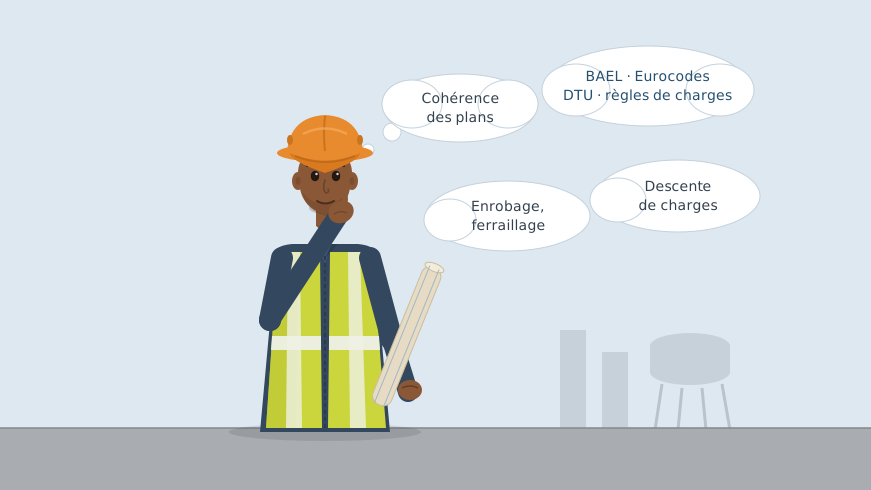
Why is the engineer systematically blamed?
When an infrastructure faces a problem, we quickly hear:
The engineer didn't do his job properly
This reaction is understandable: the engineer is seen as the one who designs, calculates, and guarantees the proper functioning of the structure. But in reality, infrastructure never depends solely on the work of the engineer. Between the studies and the actual operation of a structure, several stages and stakeholders follow one another:
Project owner → design offices → companies → control → supervision / project management → acceptance → operation → maintenance → users
An error can therefore occur at different stages of this chain: inadequate design, poor execution, lack of control, insufficient maintenance, or even changes in conditions since the structure’s design.
This does not mean that the engineer can never be responsible. When a design or sizing error is proven, their responsibility must be examined. But always attributing a problem to the engineer without analyzing the entire process oversimplifies a much more complex reality.
After design comes the reality of the field…
This is where the question of civic responsibility becomes crucial. Infrastructure can be properly designed and built, but its operation also depends on how it is used and maintained.
Waste left in the streets can be carried by rainwater to collection structures:
- plastic bags;
- bottles;
- packaging;
- household waste;
- organic waste or carcasses;
- other debris.
When they reach the manholes or networks, they can reduce their drainage capacity or cause blockages. The problem is therefore no longer solely a matter of sizing. It also becomes a matter of collective behavior.
It is not about saying:
The population is responsible for the flooding.
But to recall a reality:
Public infrastructure cannot function properly if its environment is continuously degraded by human behavior.
Civic-mindedness then becomes an essential component of the proper functioning of infrastructure.
Building is not enough: it must be maintained
We often talk about building infrastructure but less about what comes after. A sanitation network does not operate according to the principle:
Build → forget
It is better to think:
Build → control → operate → maintain → dredge → monitor
Dredging and maintenance are therefore not secondary details. They are an integral part of the operation of a sanitation system. A network whose structures are blocked or insufficiently maintained cannot be assessed solely based on its design plans. But beyond the professionals who design, build, or control it, infrastructure is above all a public asset. It is built to meet the needs of all, and its proper functioning therefore concerns each of us.
Whatever our role—engineer, contractor, decision-maker, public agent, or simply user—we all have a part to play in preserving the infrastructure that serves us daily. Living together must therefore take precedence: infrastructure is a collective asset, and its preservation is a shared responsibility.
Infrastructure is not a product that is built once and for all. It is a system that must be monitored, maintained, and adapted over time.
So, who is really responsible?
We are past the stage of pointing fingers and fueling sterile debates. If these debates do not lead to concrete actions, what is their purpose? It is time to make civic responsibility a priority. In all areas, without a minimum of individual responsibility and involvement, the results will never live up to our ambitions.
Let’s start simply by looking around us: our streets, our gutters, our sewers, the stolen or damaged covers, the waste that accumulates.
If we continue like this, what will Dakar look like in ten years? Will it still be as livable? Will we still be able to host international events in good conditions? Can our tourism industry really develop? And health?
These questions are not only for public authorities, engineers, or companies. They concern us all. Let’s start with small good actions. Let’s each try, at our own level, to take steps that can help solve these problems.
Every piece of trash thrown in the bin, however small, is a gesture that contributes to protecting our environment and improving our living conditions.
A city is not built only with concrete, roads, and networks. It is also built with the civic-mindedness of its inhabitants.
The flooding problem is therefore not just about the presence or absence of a canal or pipeline. We must also look at the city in which this infrastructure exists: how it has developed, how the land has been used, how water can circulate, and how the works are maintained.